Laminates for UV prints: the complete guide for professionals
22.04.2026 - If you work with UV prints, you’ll know that the end result depends not only on your printer or ink, but also on the right finish. The right laminate makes a huge difference to adhesion, appearance and durability. In this blog, you’ll discover why laminates for UV prints require a specific approach and how to make the best choice for a sleek and professional result.
What are the best laminates for UV prints?
The best laminates for UV prints are laminates specifically developed for UV inks, with an adhesive system that ensures strong adhesion and prevents silvering.
Grafityp UV laminates are engineered for:
- Better adhesion on UV inks
- Reduced silvering
- Easier processing
- Consistent, professional results
What is a laminate in large format printing?
A laminate is a transparent protective film applied over a printed vinyl to improve durability and appearance. In simple terms: A laminate protects your print and makes it last longer. For outdoor signage, vehicle graphics and high-traffic applications, laminates are essential.
Key benefits of laminates:
- Protects against scratches and abrasion
- Prevents fading caused by UV exposure
- Improves resistance to chemicals and cleaning
- Enhances the finish (matt, satin or gloss)
- Extends the lifespan of the print
Why do UV prints need a different laminate?
UV prints require a different laminate because UV inks behave differently from solvent or latex inks. UV inks cure instantly under UV light, forming a hard layer on top of the vinyl instead of slightly penetrating it. This creates a surface that is fundamentally different in terms of structure and adhesion.
In practice, this means the cured ink layer often has a subtle micro-texture, even if it appears perfectly smooth to the naked eye.
What is silvering in laminates?
Silvering is a visual defect where small air pockets under the laminate create a milky or silvery appearance. Silvering is one of the main reasons professionals switch to UV-specific laminates.
Why silvering happens on UV prints:
- The adhesive cannot fully bond with the UV ink surface
- Air gets trapped between laminate and print
- Light reflects through these microbubbles
Silvering will give the following results:
- Reduced print quality
- Less vibrant colours
- Unprofessional finish
How to prevent silvering on laminates for UV prints?
To prevent silvering on laminates for UV prints, you need a laminate with an adhesive system specifically designed for UV ink surfaces.
Best practices:
- Use UV-specific laminates
- Apply correct pressure during lamination
- Work at controlled speeds
- Ensure a clean working environment
- Test before full production
What makes Grafityp laminates for UV prints different?
Grafityp UV laminates are developed to ensure optimal performance on UV prints, both technically and in daily production.
Key advantages:
- Optimised adhesion for UV inks: The adhesive system is designed to improve bonding on hard UV ink surfaces.
- Reduced silvering: Better adhesive flow results in fewer air pockets and a cleaner finish.
- Easier processing: Less risk during lamination means faster and more efficient production.
- In-house R&D: Grafityp develops its own products, allowing continuous improvement based on real market needs.
- Belgian premium quality: Reliable, consistent performance across applications.
Which UV laminate should you choose?
Choosing the right UV laminate cannot be done independently from your print film. In practice, there is one key rule: always combine your laminate with a print film from the same family.
A monomeric print film should be paired with a monomeric laminate, a polymeric film with a polymeric laminate, and so on.
Why? Because both materials share the same properties in terms of flexibility, shrinkage and durability. This prevents tension in the material and ensures a stable, high-quality end result.
Grafityp offers four types of UV laminates, each specifically matched to a particular type of print film.
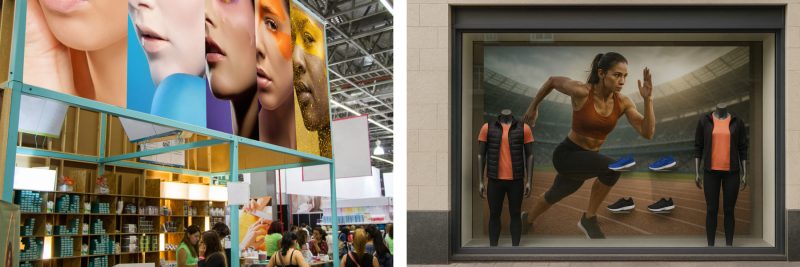
Monomeric print film + monomeric UV laminate
👉 Ideal for promotional graphics and temporary signage.
Monomeric print films are designed for straightforward applications on flat surfaces, where cost-efficiency is key.
Best for:
- Flat surfaces
- Indoor applications
- Short-term outdoor use
Key benefits:
- Cost-efficient
- Easy to process
- Available in matt and gloss
For these applications, choose a monomeric UV laminate with matching properties:
Polymeric print film + polymeric UV laminate
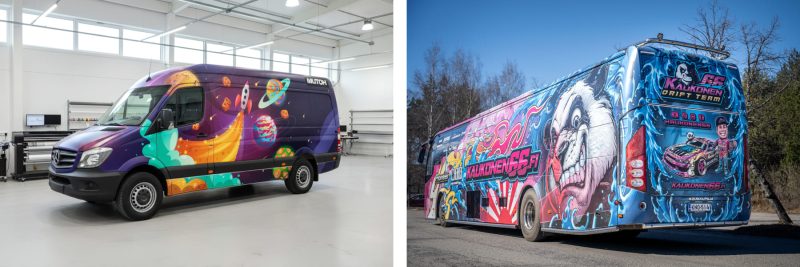
👉 The most commonly used solution for professional sign makers.
Polymeric print films are the industry standard. They offer a strong balance between flexibility, durability and cost.
Best for:
- Outdoor signage
- Slightly curved surfaces
- Medium to long-term applications
Key benefits:
- Good durability
- Better dimensional stability
- Strong adhesion on UV prints
For consistent results, these films should be combined with a polymeric UV laminate:
Cast print film + cast UV laminate
👉 The top choice for car wrappers and demanding projects.
Cast print films are developed for the most demanding applications, where maximum flexibility and conformability are required.
Best for:
- Car wraps
- Complex curves and 3D surfaces
- Long-term outdoor use
Key benefits:
- Maximum flexibility
- Excellent conformability
- Premium finish
To maintain these performance levels, choose a cast UV laminate with the same properties:

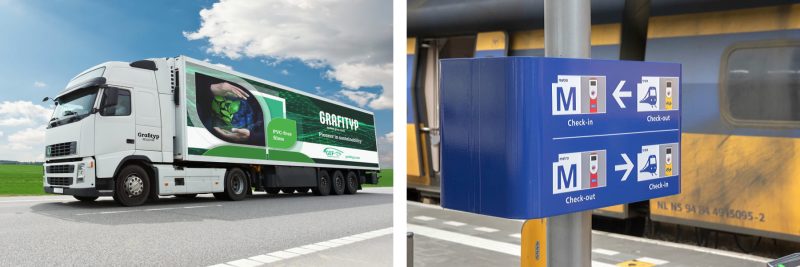
PVC-free print film + PVC-free UV laminate
In addition to traditional laminates, demand for PVC-free solutions is steadily increasing. Especially in larger projects, international environments and tenders, sustainability is becoming a decisive factor.
PVC-free no longer means compromising on performance. The latest generations are fully suitable for professional applications. Within this segment, Grafityp offers several PVC-free laminates that are compatible with UV prints. These products are the more sustainable counterpart to polymeric PVC vinyl laminates and are ideal for those who want to combine performance with a more environmentally conscious material choice.
Best for:
- outdoor applications
- slightly curved surfaces
- medium to long-term use
- projects with sustainability requirements
- companies with ESG objectives
Key benefits:
- PVC-free composition
- suitable for UV printed applications
- strong adhesion on UV inks
- more sustainable alternative within professional print applications
- combines ease of processing with a more environmentally responsible material choice
For these applications, choose a PVC-free UV laminate that perfectly matches these films:
What happens if you use the wrong laminate on UV prints?
Using the wrong laminate doesn’t always lead to immediate failure, which is why it’s sometimes underestimated. But over time, the consequences become clear. You may see:
- inconsistent finishes across jobs
- visible silvering under certain lighting
- reduced lifespan of the print
- increased production time due to rework
In a competitive market, these issues don’t just affect quality, they affect margins and reputation.
Why laminates are critical for professional results
A high-quality print is only part of the final result. Laminates are not an accessory, they are a core part of the system.
Without the right laminate:
- Colours lose depth
- Prints wear faster
- Surfaces become vulnerable
With the right laminate:
- Prints look better
- Last longer
- Perform consistently
Practical tips for laminating UV prints
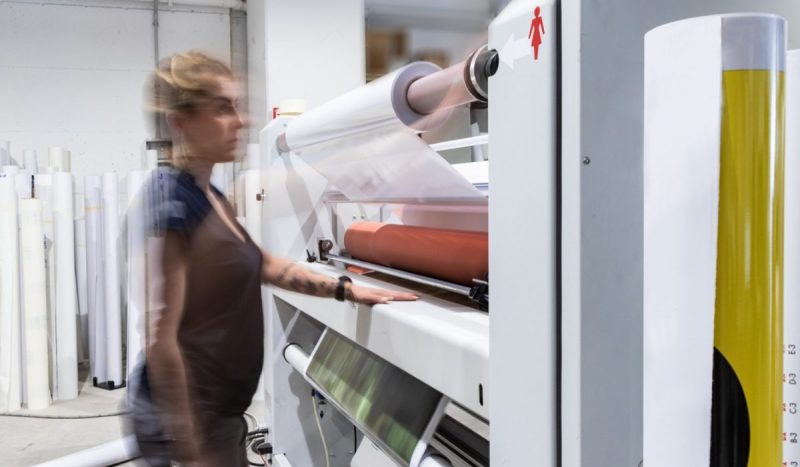
Even with the right laminate, results depend on how you process it. From experience, a few factors consistently make a difference:
- Use the correct laminate: Always choose a laminate designed for UV inks.
- Control your process: Adjust pressure and speed for optimal adhesive flow.
- Work clean: Avoid dust and contamination.
- Test combinations: Different printers and inks can behave differently.
Why professionals switch to specific laminates for UV prints
More and more professionals are moving away from general-purpose laminates when working with UV prints. Not because standard laminates are unusable, but because they introduce uncertainty. UV-specific laminates remove that uncertainty. They make the process more predictable, reduce the risk of defects and ultimately save time. And in a production environment, that reliability is often more valuable than the material cost itself.
Conclusion: the right laminate makes the difference
In UV printing, the laminate you choose directly influences the final result. It determines how your print looks, how long it lasts and how efficiently you can produce it. Standard laminates may work in some cases, but they rarely deliver consistent, high-end results on UV prints. Laminates developed specifically for UV inks, like those from Grafityp, are designed to eliminate the most common issues and simplify the process.
And in the end, that’s what professionals are looking for: control, consistency and quality.
Want to test the difference yourself?
The best way to evaluate a laminate is not on paper, but on your own prints.
👉 Request a sample from your distributor and test it on your own UV prints
👉 Contact your distributor for tailored advice
Because in professional printing, details make the difference, and laminates are one of the most important ones.
More news
We help to make brands stick. To do this in the best possible way, a good knowledge of the material is essential. Of films and of adhesives. And of the perfect mix for each application. In our blog we share this knowledge with you and we keep you posted on the latest news facts from our company and from our sector.
Back to the overview